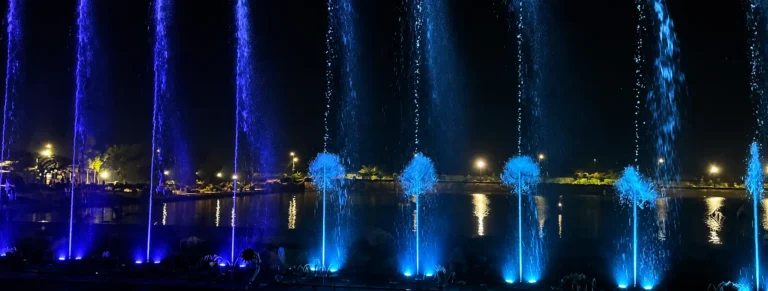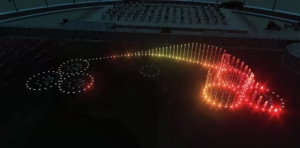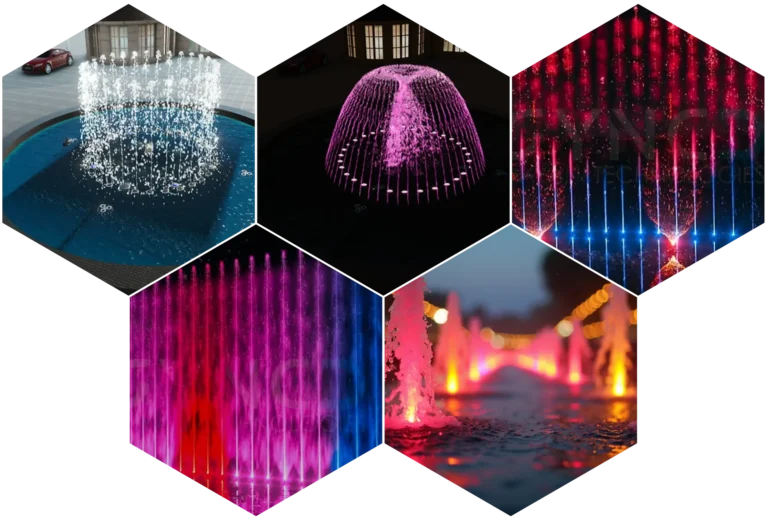
Clients may find it difficult to imagine a moving water show from equipment lists and technical drawings alone.
Animation gives those details a visual form. It helps answer practical design questions:
Does the fountain suit the available space?
Is the central effect visually dominant enough?
Are there too many competing water patterns?
Does the proposed arrangement complement the architecture?
For example, an arrangement that looks balanced on a plan may appear crowded when several effects operate together. Reviewing an animation creates an opportunity to adjust that composition early.
A musical fountain must look effective throughout a sequence, including the transitions between patterns.
An attractive still image cannot show whether a transition feels abrupt, whether an effect remains active too long, or whether the finale has enough visual contrast.
Animation allows the creative team to review the flow of the performance. Quiet passages can use restrained movement, while stronger musical sections can introduce larger patterns and brighter lighting.
This helps develop a show with variety and a clear sense of progression.
Music gives a fountain show its rhythm and emotional direction. Choreography determines how water and light respond to that rhythm.
A 3D preview helps designers explore where to introduce an effect, how long to hold it, and how to transition into the next sequence.
For example, a gentle introduction might begin with low jets and soft colour changes. As the music builds, additional water patterns can enter before a coordinated finale.
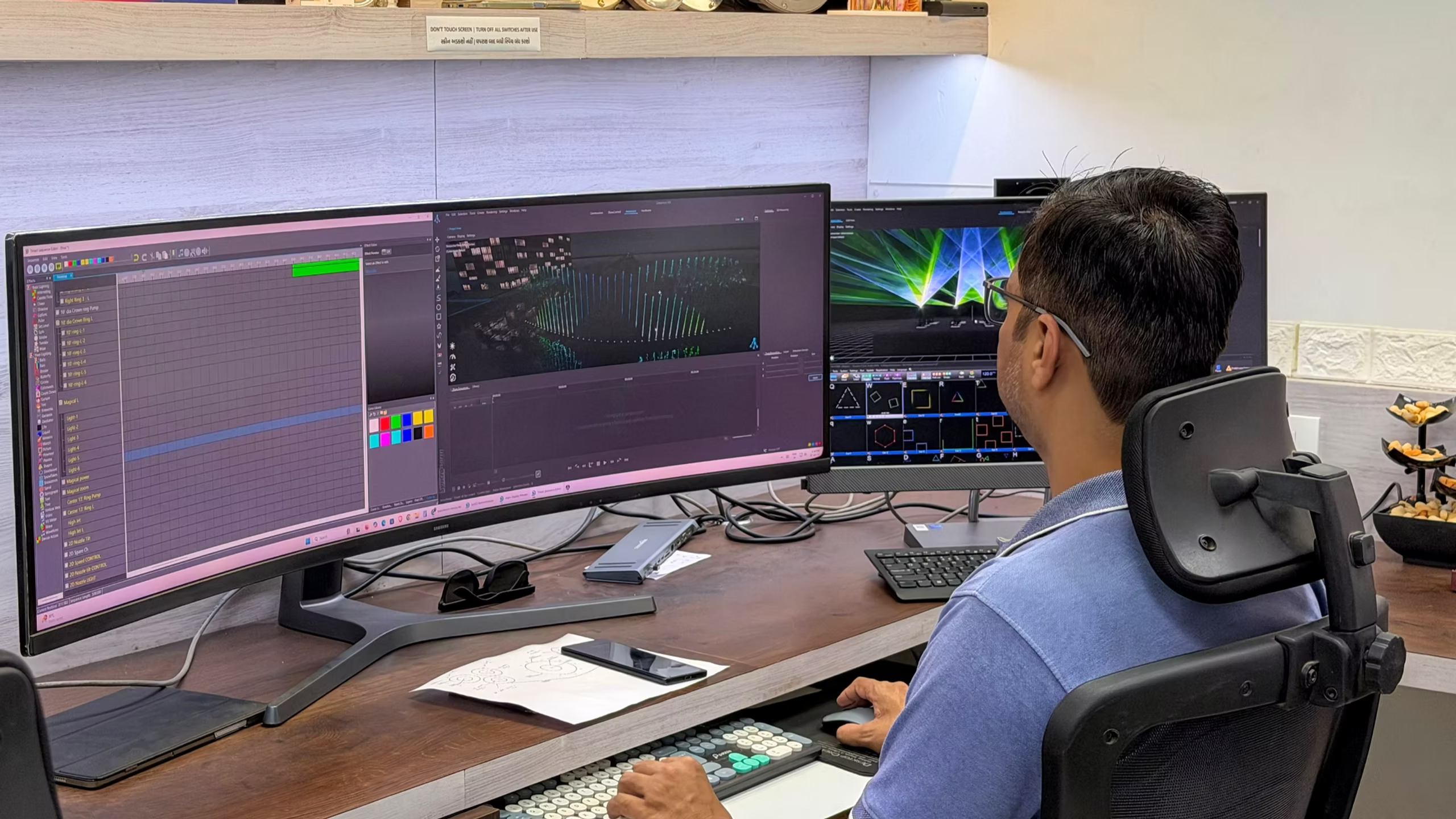
Final synchronisation still requires testing on the installed fountain. Actual pump acceleration, valve response, water travel time, and control settings affect when the audience sees each effect.
Fountain projects often involve several people with different responsibilities: owners, architects, landscape designers, consultants, and installation teams.
A shared animation gives everyone a common visual reference.
Instead of discussing an abstract request such as “make the fountain more dynamic,” the team can identify a specific moment and propose a clear adjustment—for example, changing the order of effects or reducing the height of a foreground jet.
This makes feedback more specific and helps document what has been agreed.
The fountain’s main viewing position may differ from the angle used in a presentation image.
A show could be viewed from a temple courtyard, hotel entrance, public seating area, walkway, or balcony. Each position changes how the water patterns overlap and how the fountain relates to its surroundings.
A 3D scene can be reviewed from selected viewpoints to explore:
Whether foreground effects obscure features behind them.
How the fountain appears against the building or landscape.
Whether the composition feels balanced from the main audience area.
Which effects deserve emphasis from the intended viewing direction.
These reviews help keep the audience experience central to the design.
Lighting changes the character of a fountain after dark. Colour choices can make the same water pattern feel calm, festive, dramatic, or devotional.
Animation provides a useful way to compare creative options:
A single colour across the full fountain.
Contrasting colours for separate groups of jets.
Gradual colour transitions.
Changes timed to musical phrases.
Distinct colour themes for different show sections.
The preview establishes the intended visual direction. Actual brightness and colour appearance must be checked on site because fixtures, water conditions, ambient light, and viewing distance influence the result.
Design revisions are easier to discuss while the project is still digital.
If the client wants a different arrangement, a more prominent central effect, or a revised sequence, the team can review that proposal before committing to physical changes.
Early decisions help avoid situations where a visual preference emerges only after pipework, supports, cables, and equipment have been installed.
The value of animation is greatest when it is included during concept development and coordinated with the technical design.
A 3D model can provide useful spatial context for the engineering team. When modelled to an appropriate level of detail, it can help review equipment locations, pipe routes, access areas, and potential clashes.
However, a convincing animation is not proof that a fountain will perform as shown.
Pump selection, nozzle performance, pressure losses, structural requirements, electrical protection, and splash behaviour need their own engineering checks. Wind and site conditions also require consideration.
Animation communicates the intended result; engineering establishes how that result can be achieved.
An approved animation can act as a creative reference during programming.
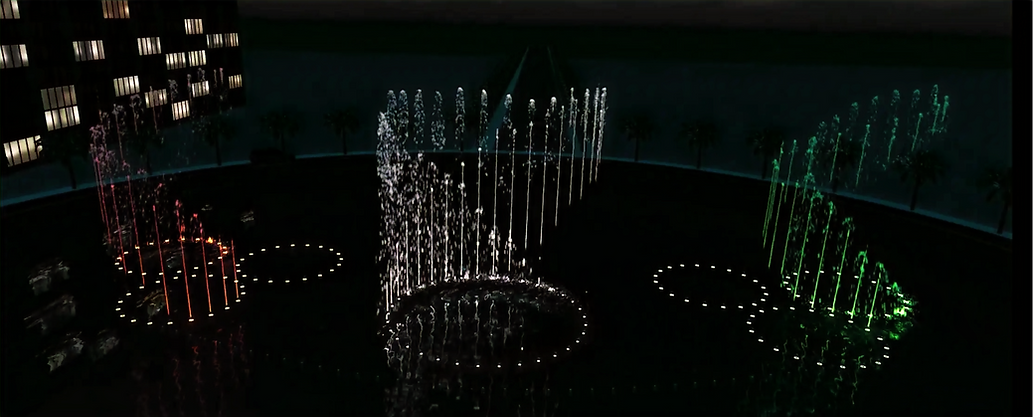
It helps communicate the intended sequence of water effects, colour changes, and transitions. This gives the programmer and client a shared basis for reviewing the installed show.
The animation should be supported by clear equipment schedules, device mappings, and control requirements. A rendered video does not automatically become a controller-ready show file; that depends on the software workflow and system capabilities.
During commissioning, the programme is adjusted to match the behaviour of the actual equipment.
A memorable musical fountain needs more than a collection of effects. It needs a sequence that holds attention.
Animation allows the team to review the show as a complete experience. Does the opening establish the mood? Do repeated patterns become predictable? Does the finale feel distinct from what came before?
These questions help turn individual effects into a connected performance.
For a devotional setting, the focus may be graceful movement and carefully timed musical moments. For a public attraction, the design may call for stronger contrasts and more energetic transitions. The creative direction should suit the location and purpose.