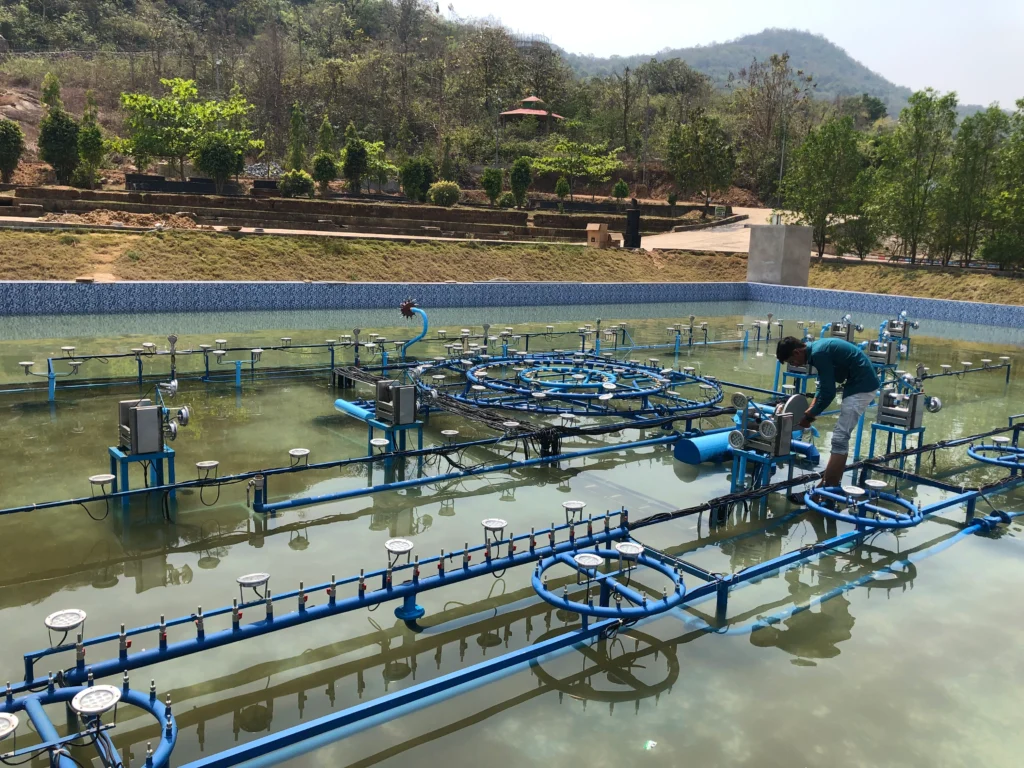
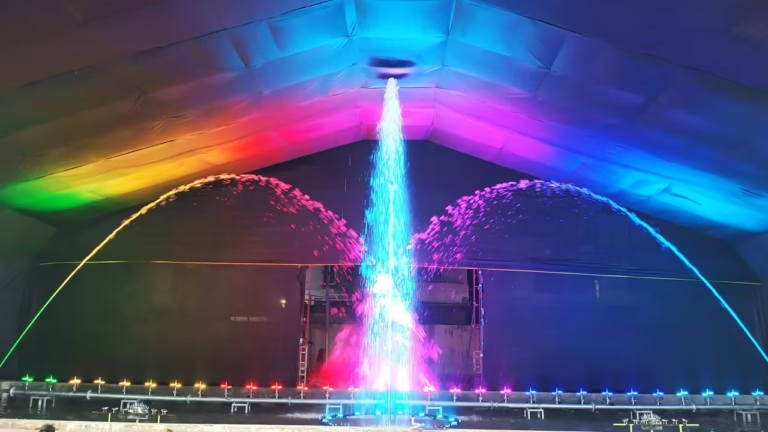
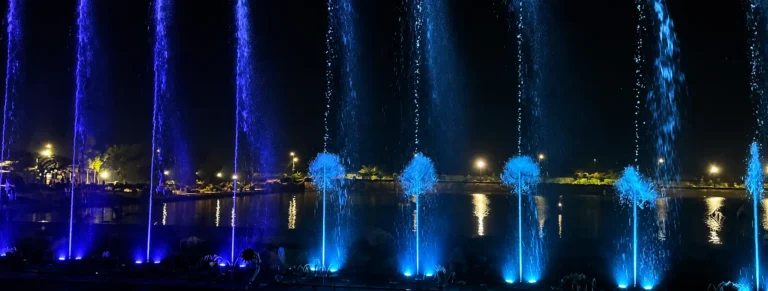
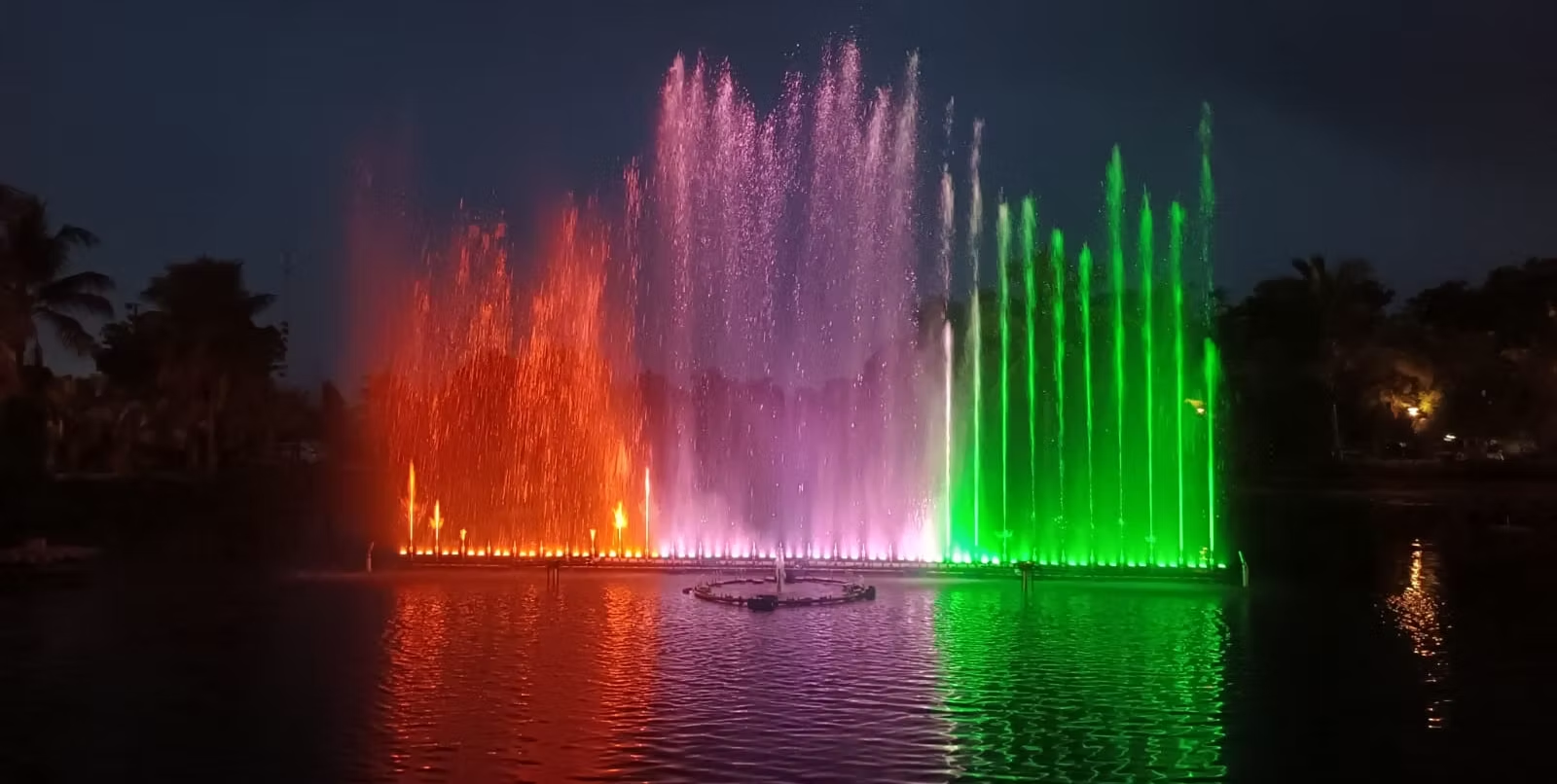
A musical fountain brings water, lighting, and music together in a carefully programmed performance. Keeping that performance consistent requires regular care of the complete system—from pumps and nozzles to underwater lights, control panels, and show-control software.
Blocked nozzles, dirty filters, faulty solenoid valves, or loose electrical connections can gradually affect the appearance and reliability of a fountain. A planned maintenance routine helps identify these problems early, reduce unexpected downtime, and protect your investment.
This guide from Dhyani Technologies explains the essential maintenance practices for musical and dancing fountains in temples, hotels, gardens, commercial developments, and public spaces.
A short inspection before startup can prevent a small issue from interrupting the entire performance.
Check that:
The water level is within the system’s marked operating range.
Pump intakes and strainers are clear of leaves, plastic, and other debris.
Nozzles are secure and point in the correct direction.
There are no visible leaks, damaged cables, or broken light fittings.
The control panel shows no active alarms.
Pumps, lights, valves, and music respond during a short test sequence.
Watch for changes from normal operation, such as reduced jet height, unusual pump noise, delayed water effects, or flickering lights. Record these observations for the maintenance team.
Never operate a pump below its required water level or minimum flow conditions.
Water quality directly affects fountain performance. Dirt can block small nozzle openings, while algae and mineral deposits can collect on lights, pipes, and internal components.
A practical cleaning routine includes:
Removing floating debris regularly.
Cleaning strainers and maintaining filters according to their condition and manufacturer instructions.
Removing sediment from the basin before it accumulates around pump intakes.
Cleaning algae from accessible surfaces.
Checking water clarity, odour, and signs of excessive scaling.
Use a water-treatment programme suitable for the fountain’s materials, equipment, and public exposure. Chemical selection and dosing should be established by a competent water-treatment specialist.
Avoid adding household detergents or unapproved chemicals. These may cause foaming, damage seals, or affect metal surfaces.
Clear-looking water is not necessarily hygienically safe. Decorative fountains that produce spray need appropriate water-quality management as well as visual cleaning.
Nozzles determine the shape, height, and direction of every water effect. Even a small blockage can make a straight jet appear uneven or disturb an arching pattern.
During nozzle maintenance:
Stop the fountain and isolate the relevant equipment.
Identify and mark the nozzle position before removal.
Clean deposits using methods approved for the nozzle material.
Flush debris from the relevant line where the system allows.
Refit the nozzle and check its alignment.
Run a controlled test and compare it with neighbouring jets.
Do not use tools that enlarge or scratch the nozzle opening. Avoid harsh abrasives on stainless-steel surfaces.
For moving or rotating nozzles, also inspect mounting hardware, cable movement, and the mechanism according to the equipment manual.
Pumps provide the flow and pressure required for the fountain’s water patterns. Reduced performance may result from blocked intakes, low water levels, air entering the system, impeller wear, or other hydraulic problems.
Monitor:
Jet height and consistency.
Unusual noise or vibration.
Pump operating current.
Leakage around accessible pipe connections and seals.
VFD fault history, where variable-frequency drives are installed.
Compare readings under the same operating conditions, such as the same test pattern and VFD frequency. This makes changes easier to identify.
If jet height drops, investigate the cause before increasing pump speed. A higher speed may mask an underlying blockage or push equipment beyond its intended operating range.
Pump disassembly, seal replacement, and motor testing should be performed by trained technicians.
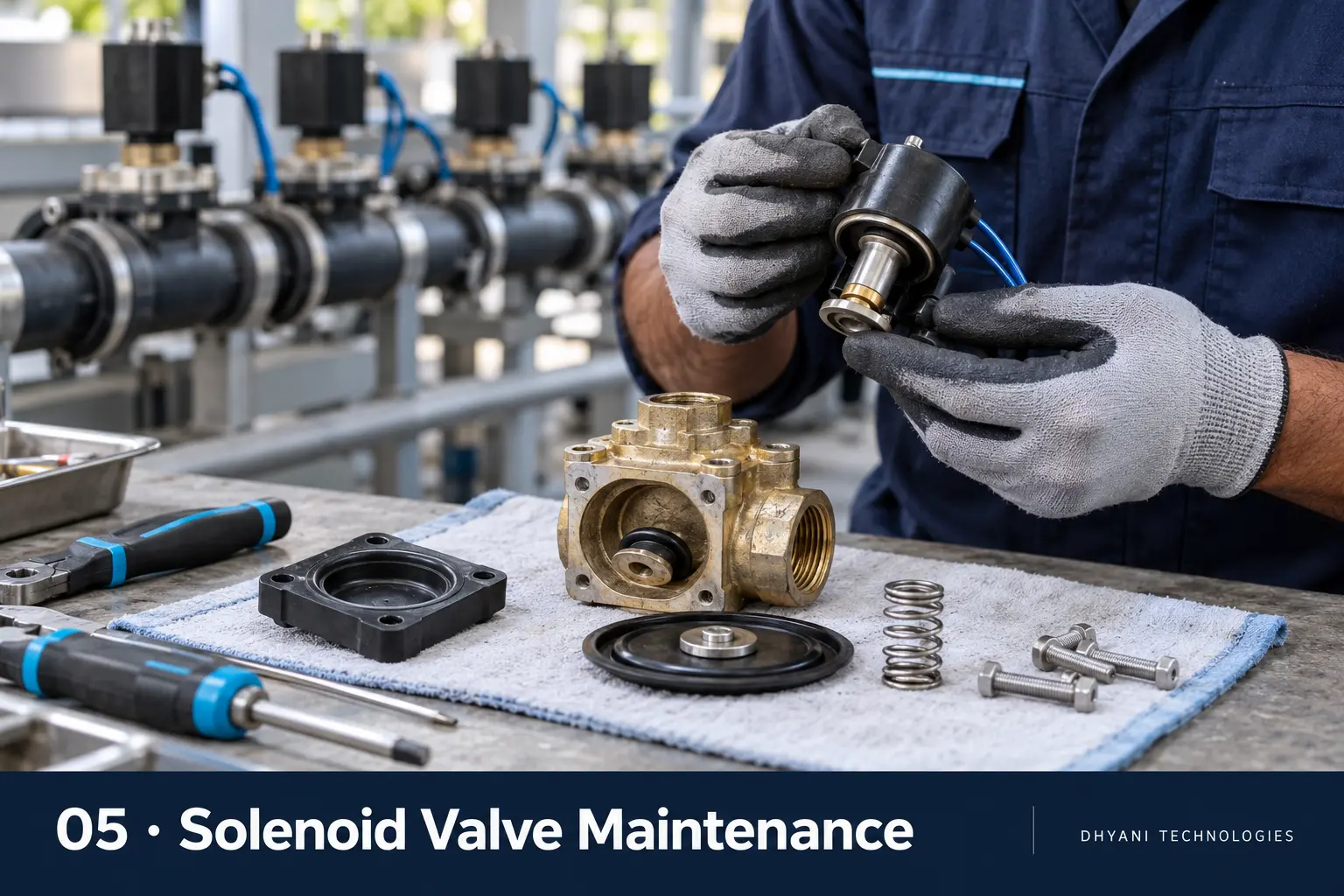
Solenoid valves control rapid water switching in chasing jets and other sequenced effects. A sticking or slow valve can make the fountain appear out of sync even when the show programme is correct.
Inspect valves for:
Failure to open or close.
Water passing when the valve should be shut.
Delayed or inconsistent response.
Debris around internal valve components.
Damaged wiring, connectors, seals, or coils.
Test valves individually using a maintenance sequence. This helps separate a mechanical fault from a decoder, wiring, or programming issue.
Before opening a valve, isolate electrical power and release water pressure. Use replacement parts compatible with the valve model and operating conditions.
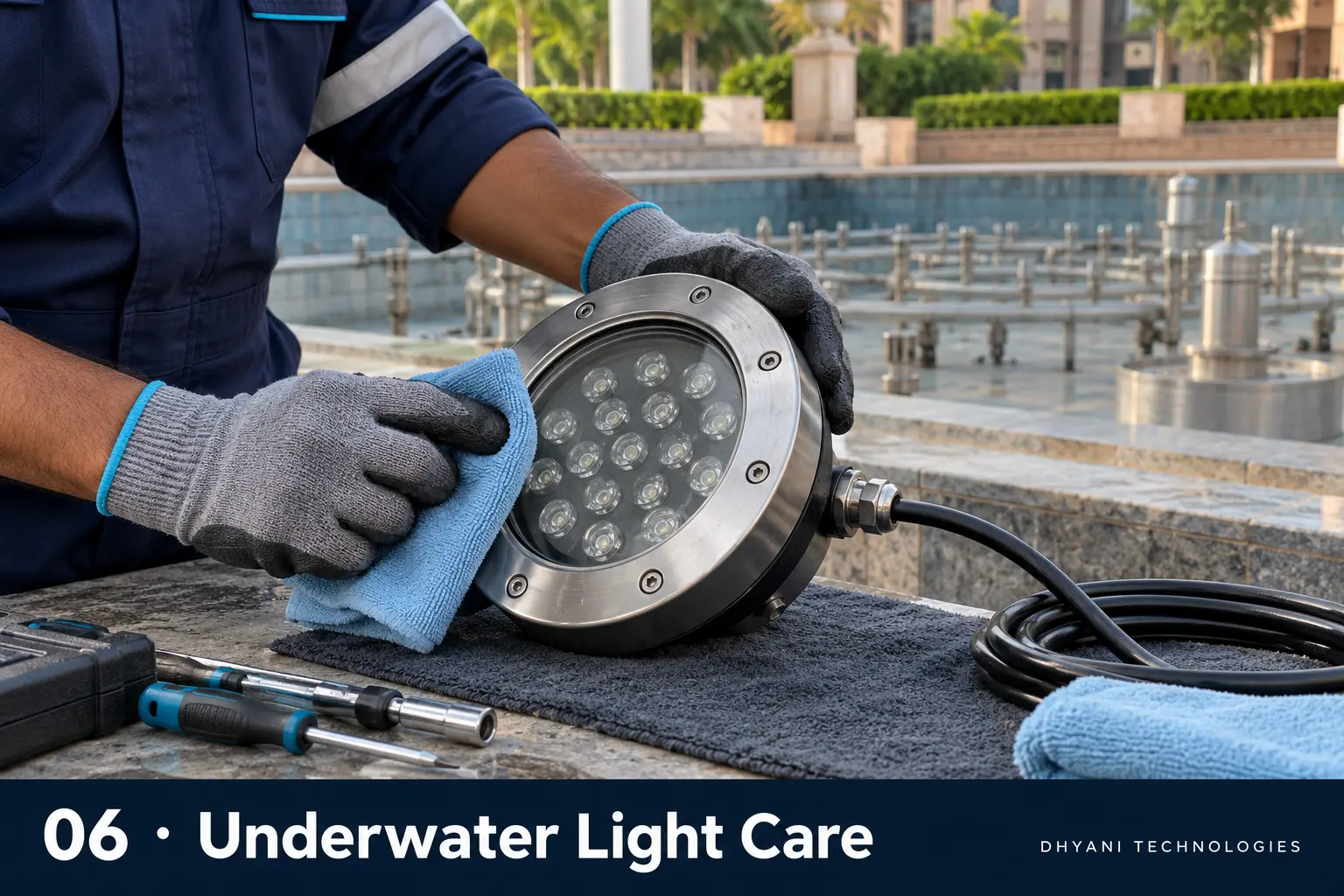
Underwater lighting gives a musical fountain its colour and visual impact. Dirt on the lens can reduce brightness, while moisture ingress or damaged connections can cause intermittent operation.
Routine checks should include:
Cleaning lenses with a soft cloth and a compatible cleaning method.
Checking brackets and light alignment.
Inspecting visible cables and cable glands.
Looking for moisture inside the fitting.
Testing red, green, blue, and white channels separately, where fitted.
Comparing colour and brightness across similar fixtures.
A colour mismatch does not always mean that the complete light has failed. The cause may be a failed LED channel, incorrect DMX addressing, a decoder issue, or a power-supply fault.
An IP68 rating does not remove the need to inspect seals and connections. Follow each product’s stated immersion and installation conditions, and do not run a submerged-only light dry unless the manufacturer permits it.
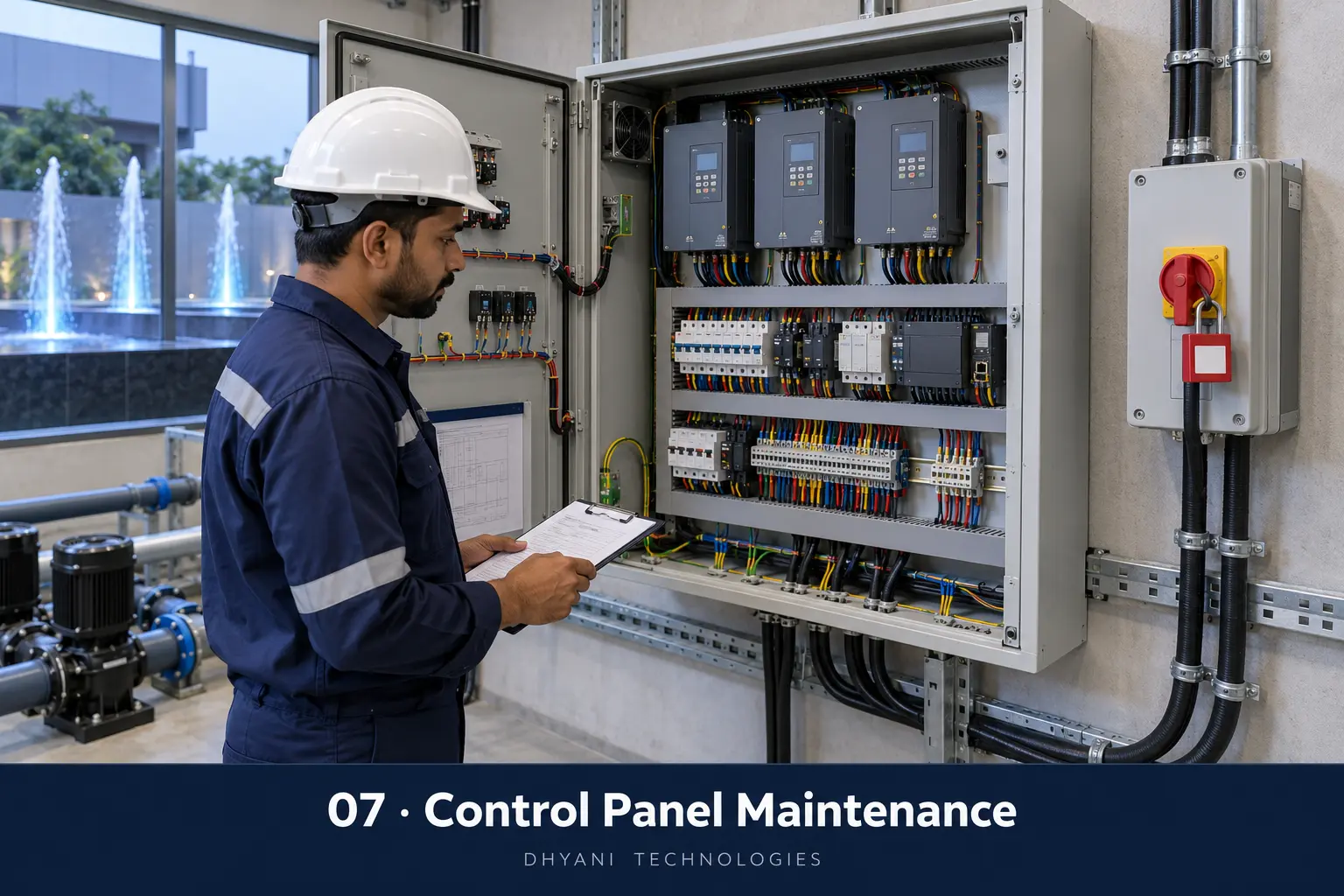
Control panels contain the equipment that coordinates power distribution, pump speed, valve operation, and lighting.
Dust, insects, condensation, and blocked ventilation can affect reliability. Scheduled inspections should cover:
Door seals and cable-entry glands.
Cooling fans and ventilation filters.
Signs of moisture, corrosion, overheating, or discolouration.
Power supplies, contactors, VFDs, and protection devices.
Terminal condition and connections.
Earthing and electrical protection.
Electrical maintenance must be carried out by qualified personnel. Isolate and lock out power before servicing, verify that the equipment is de-energised, and observe the VFD manufacturer’s capacitor-discharge waiting time.
Do not wash electrical panels or repeatedly reset a protective device without identifying why it operated.
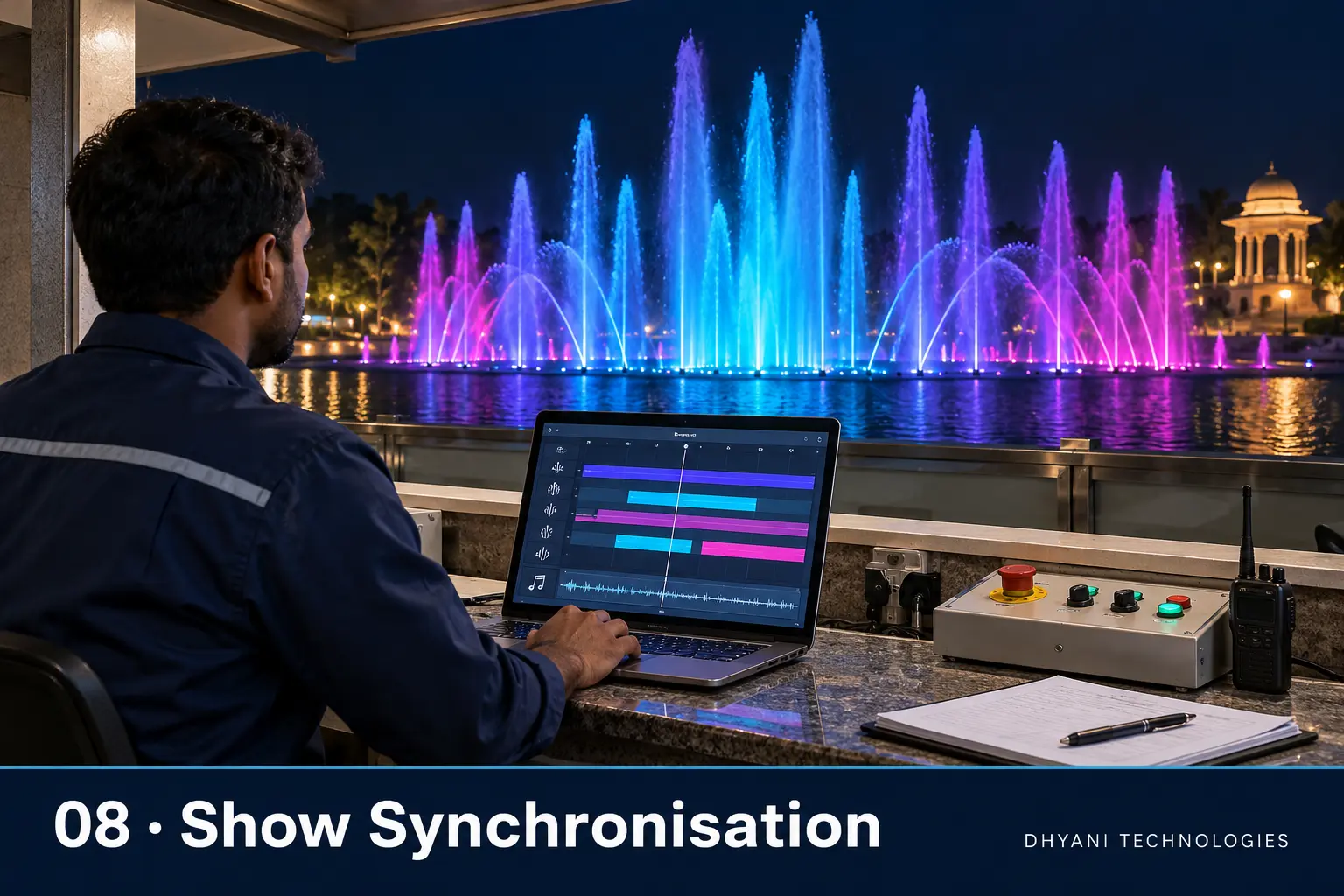
A musical fountain depends on reliable communication between the show controller, lighting decoders, valve controllers, and pump-control interfaces.
When effects become irregular or lose synchronisation, check:
Device addresses and channel assignments.
Signal cables, connectors, and junction boxes.
DMX polarity and termination appropriate to the installation.
Splitter outputs and affected signal branches.
Network connections and settings in Art-Net systems.
Audio or timecode settings used by the show.
Use a structured test: pumps first, then valves, lights, and finally the complete show. This makes the source of a fault easier to locate.
For fountains using SyncD show-control systems, keep backups of show files, device mappings, network settings, and relevant controller configurations. Test software or configuration changes before returning the fountain to normal public operation.

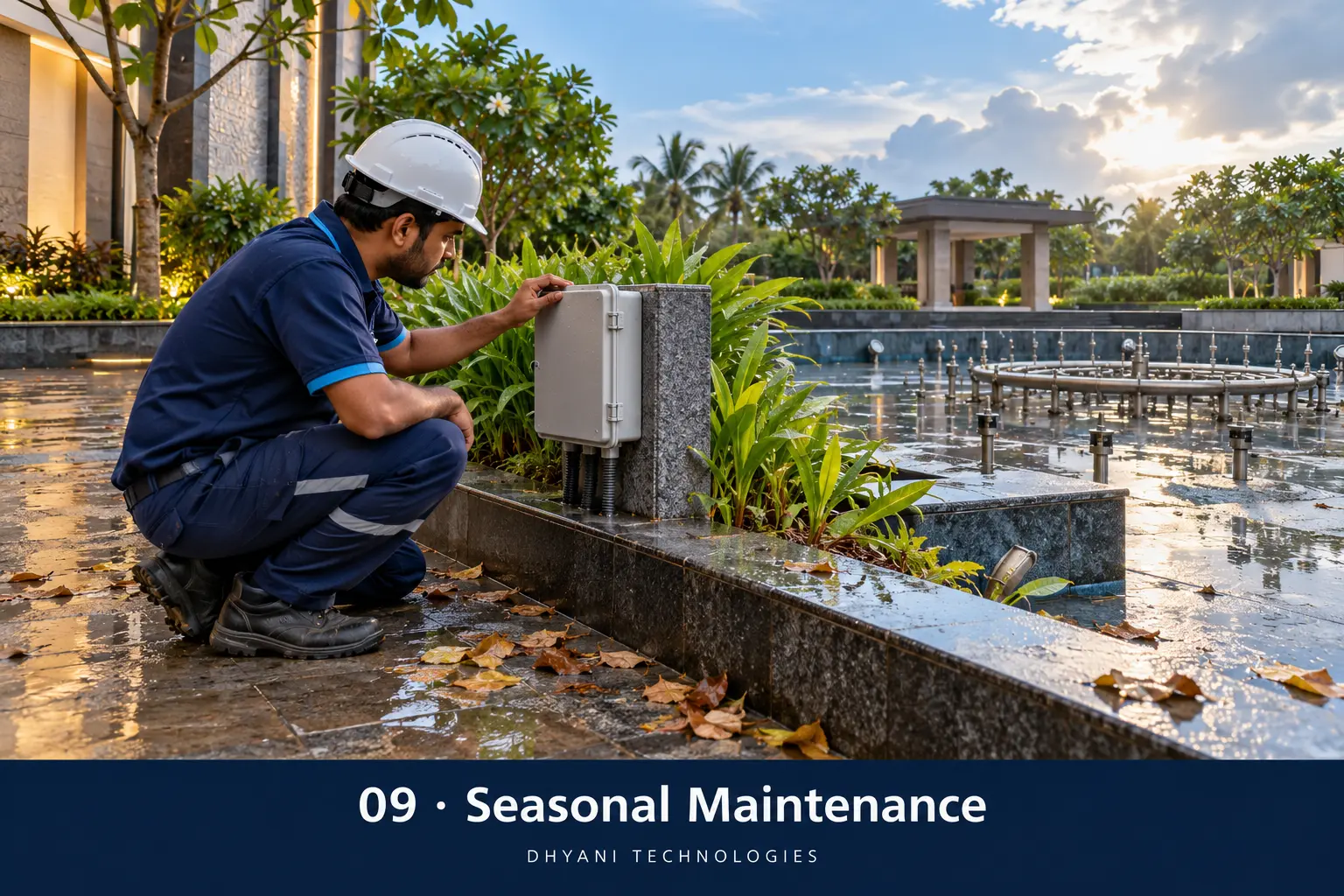
Outdoor fountains face different conditions throughout the year.
Check water levels more frequently because evaporation and splash losses can increase. Monitor algae growth and panel ventilation, and keep equipment within its specified temperature limits.
Inspect drainage, panel seals, cable entries, and junction boxes. Remove storm debris promptly. Equipment affected by flooding should be inspected before it is re-energised.
Follow the equipment manuals for draining, storage, and preservation. Avoid leaving unmanaged stagnant water in the basin.
Where freezing conditions occur, use an equipment-specific winterisation plan; frost protection varies between products.
The schedule below is a starting point. Adjust it according to operating hours, water quality, weather, site conditions, and manufacturer requirements.
| Frequency | Recommended activities |
|---|---|
| Before each show / daily | Check water level, remove debris, review alarms, and run a short functional test. |
| Weekly | Inspect strainers, nozzle alignment, light lenses, and valve response; clean as required. |
| Monthly | Review pump readings and fault logs, inspect accessible fittings, and verify control-system backups. |
| Quarterly | Arrange a technical inspection of pumps, valves, panels, signal distribution, and show synchronisation. |
| Annually / planned shutdown | Carry out a comprehensive condition assessment, required servicing, electrical protection checks, and operator refresher training. |
Heavy-use fountains or sites with dusty surroundings and hard water may need more frequent attention.
| Problem | Possible causes | Recommended first action |
|---|---|---|
| Low or uneven jet height | Blocked nozzle or strainer, low water level, leakage, or pump issue | Check water level and restrictions before changing operating settings. |
| A jet remains on | Sticking valve, debris, or an unintended control output | Isolate the affected circuit and check valve operation and control separately. |
| Flickering lights | Power-supply issue, loose connection, moisture, or signal fault | Identify the affected power or signal branch and arrange inspection. |
| Incorrect colours | Failed LED channel, wrong address, mapping error, or decoder fault | Run individual colour-channel tests. |
| Effects out of sync | Valve response, hydraulic delay, communication, or timing issue | Test each subsystem before adjusting choreography. |
| Repeated electrical trips | Leakage, overload, short circuit, or equipment fault | Stop operation and have the cause investigated by a qualified technician. |
| Green or cloudy water | Inadequate filtration, contamination, or water-treatment problems | Review cleaning, filtration, and the water-treatment programme. |
These symptoms can have more than one cause. Diagnosis should come before component replacement.
A simple maintenance record helps operators identify recurring faults and plan repairs.
Record the date, operating hours, fault symptoms, affected equipment, test readings, work completed, and parts replaced. Add photographs where useful.
Maintain an updated equipment register with pump models, valve types, light specifications, decoder addresses, and panel drawings. Accurate records make troubleshooting and future upgrades easier.
Dhyani Technologies provides fountain operation and maintenance services, technical support, and system upgrade assistance. A site assessment can help establish the maintenance scope, identify faulty equipment, and prioritise corrective work.
For fountain owners and facility managers, a planned maintenance programme helps keep water patterns consistent, lighting effective, and shows ready for their audience.
Need maintenance support for your musical fountain?
Contact Dhyani Technologies to discuss a site inspection and maintenance plan.
Explore expert insights, practical guides, and the latest innovations in water show choreography, fountain design, and smart lighting technologies.
From musical fountain programming to advanced multimedia integration, our blog covers everything you need to create immersive and high-performance water shows in India and beyond.
We are recognised as noteworthy manufacturer and supplier of a broad assortment of Fountains such as Indoor Fountains, Outdoor Fountains and Digital Water Curtains.
Copyright © 2026 SyncD | Dhyani Technologies | All Rights Reserved.