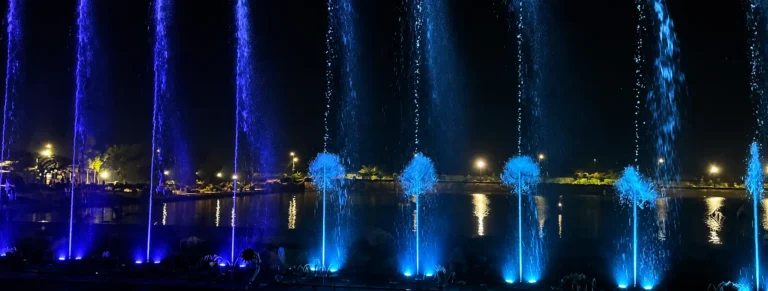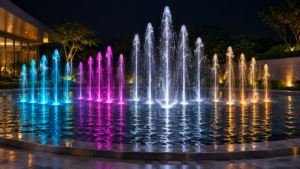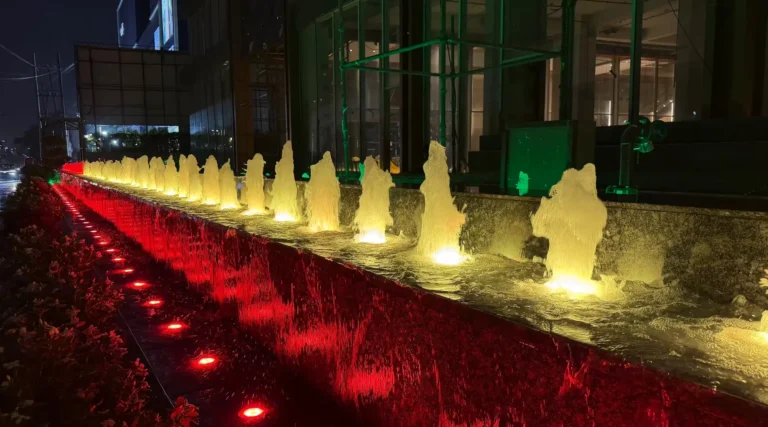
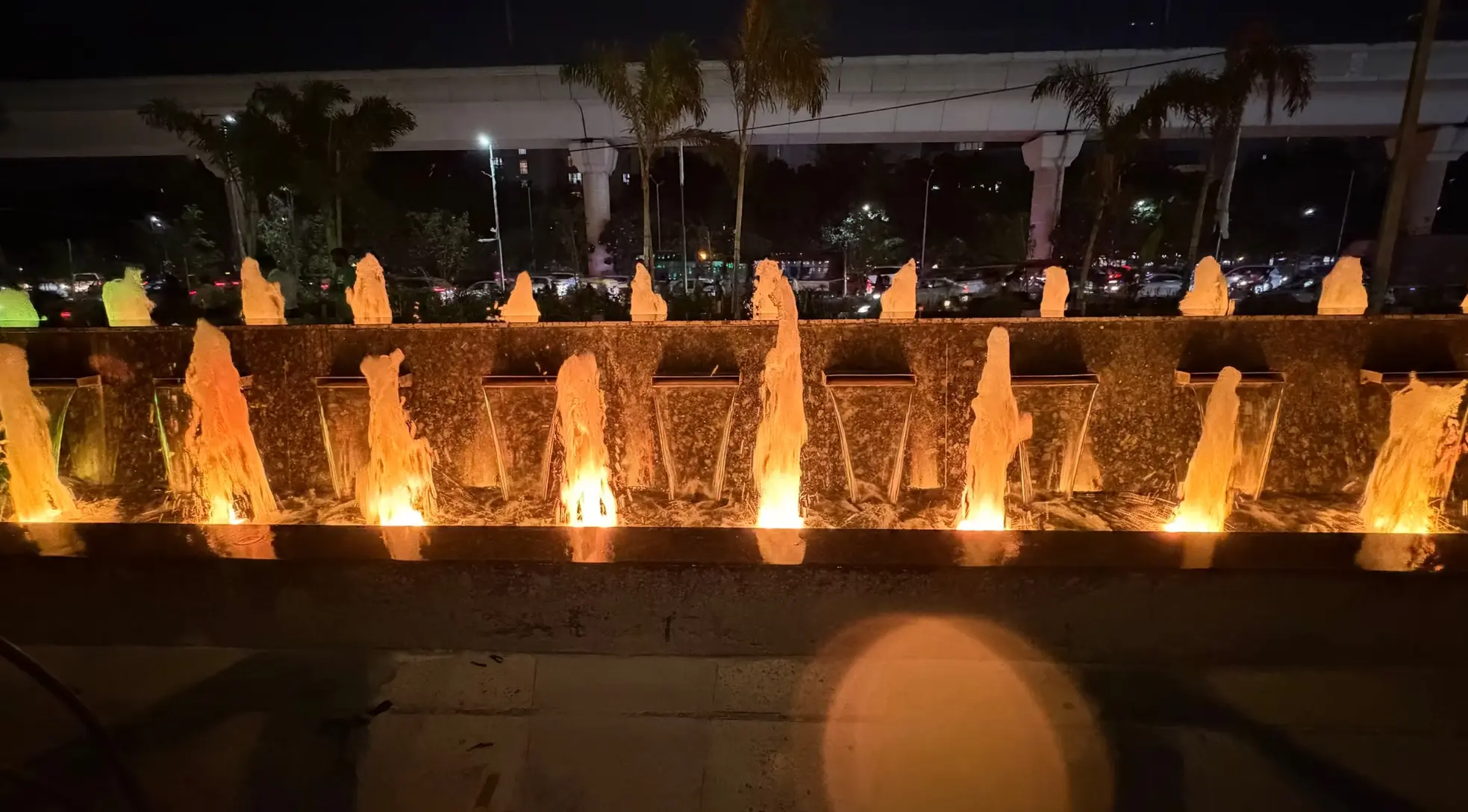
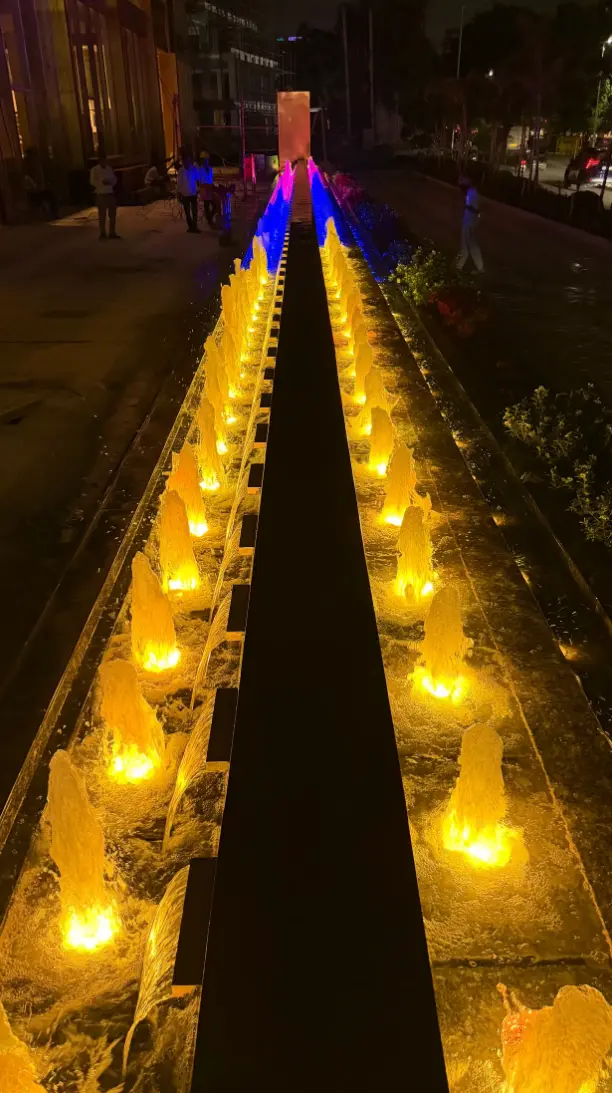
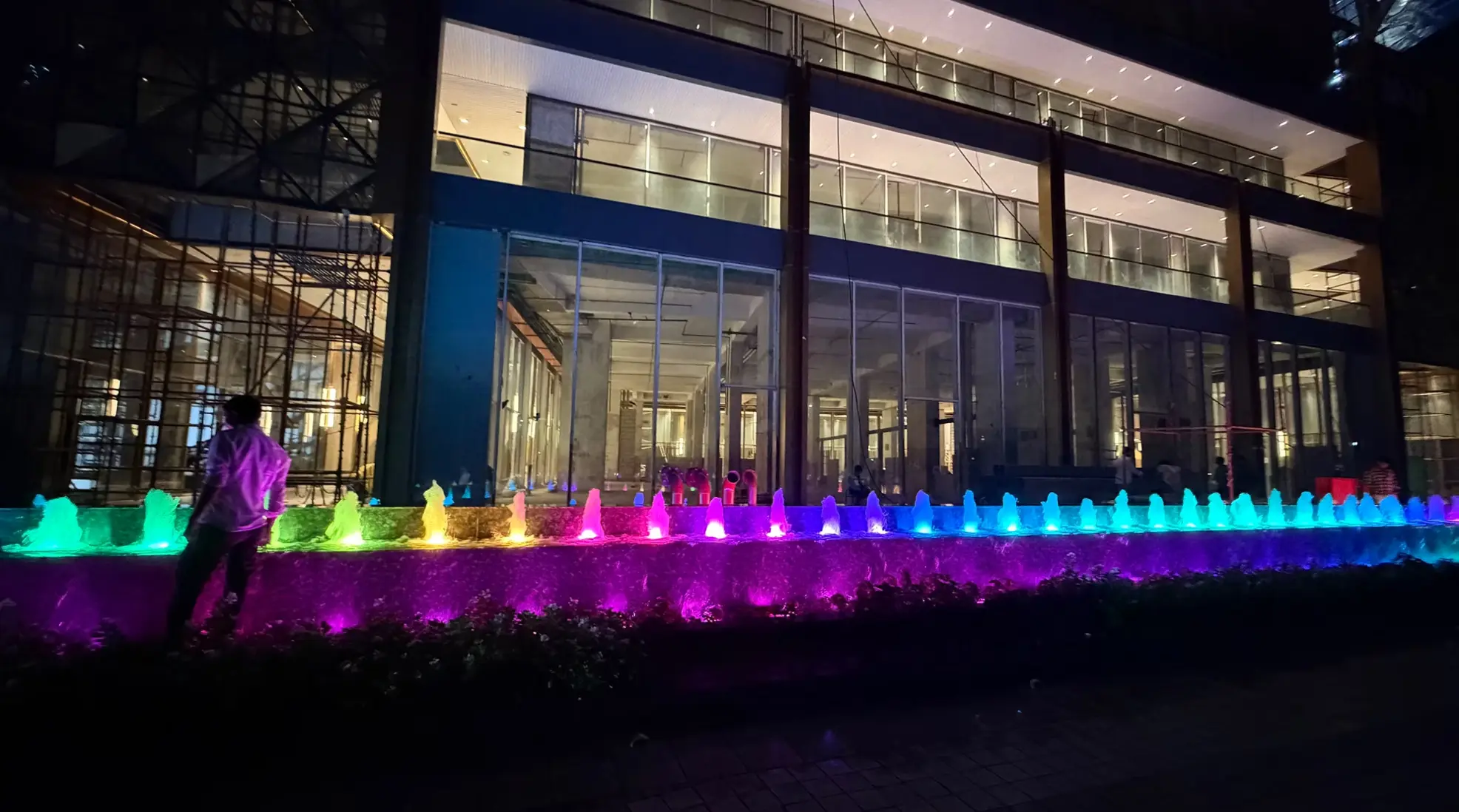
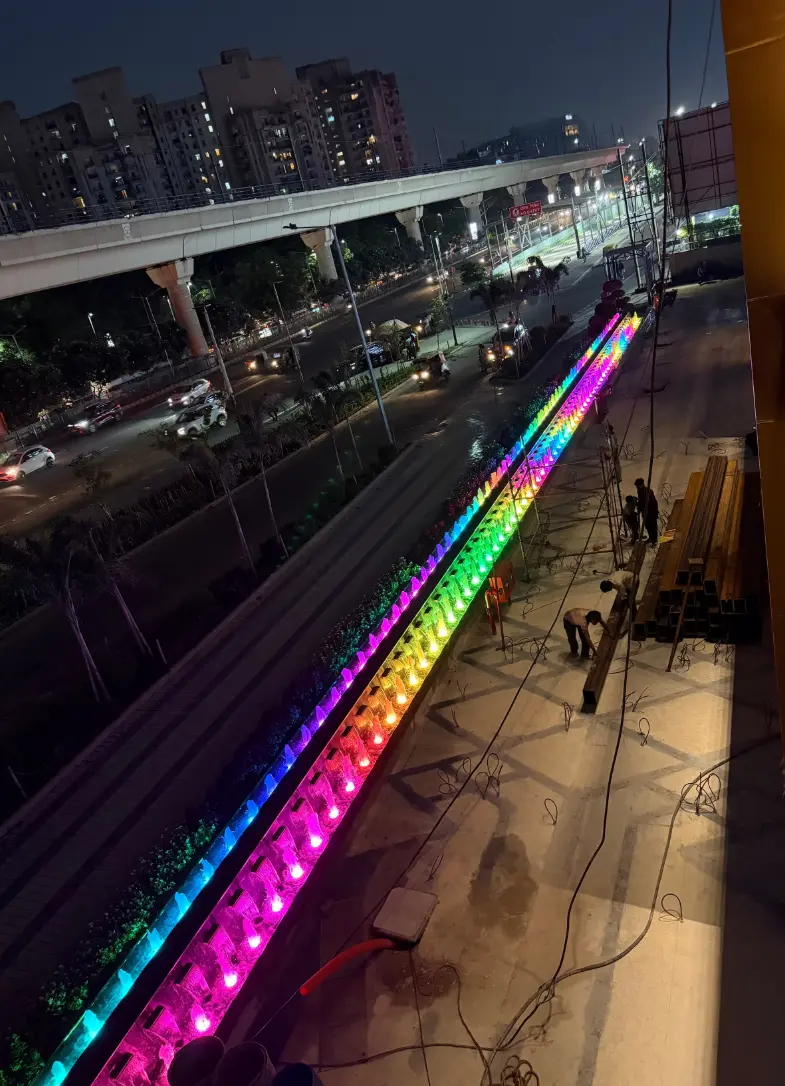
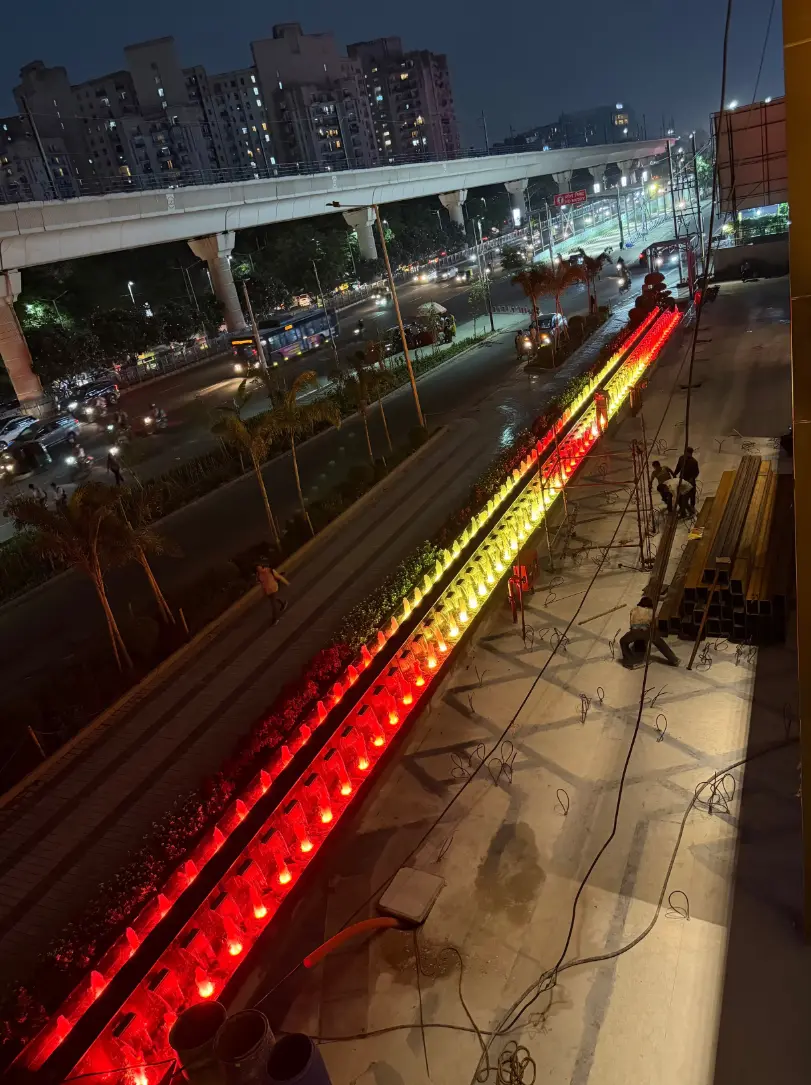
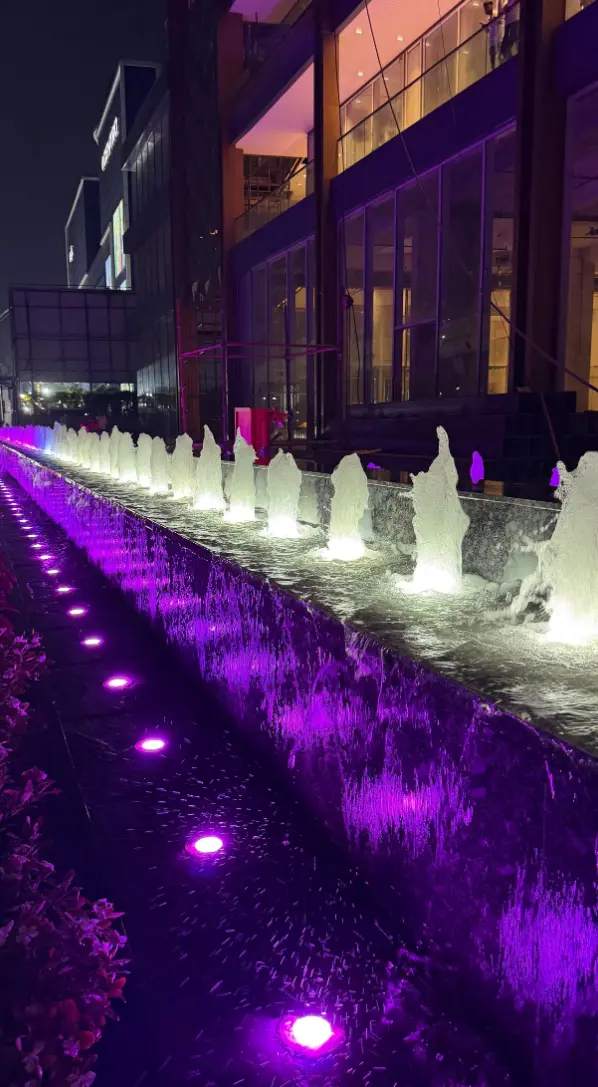
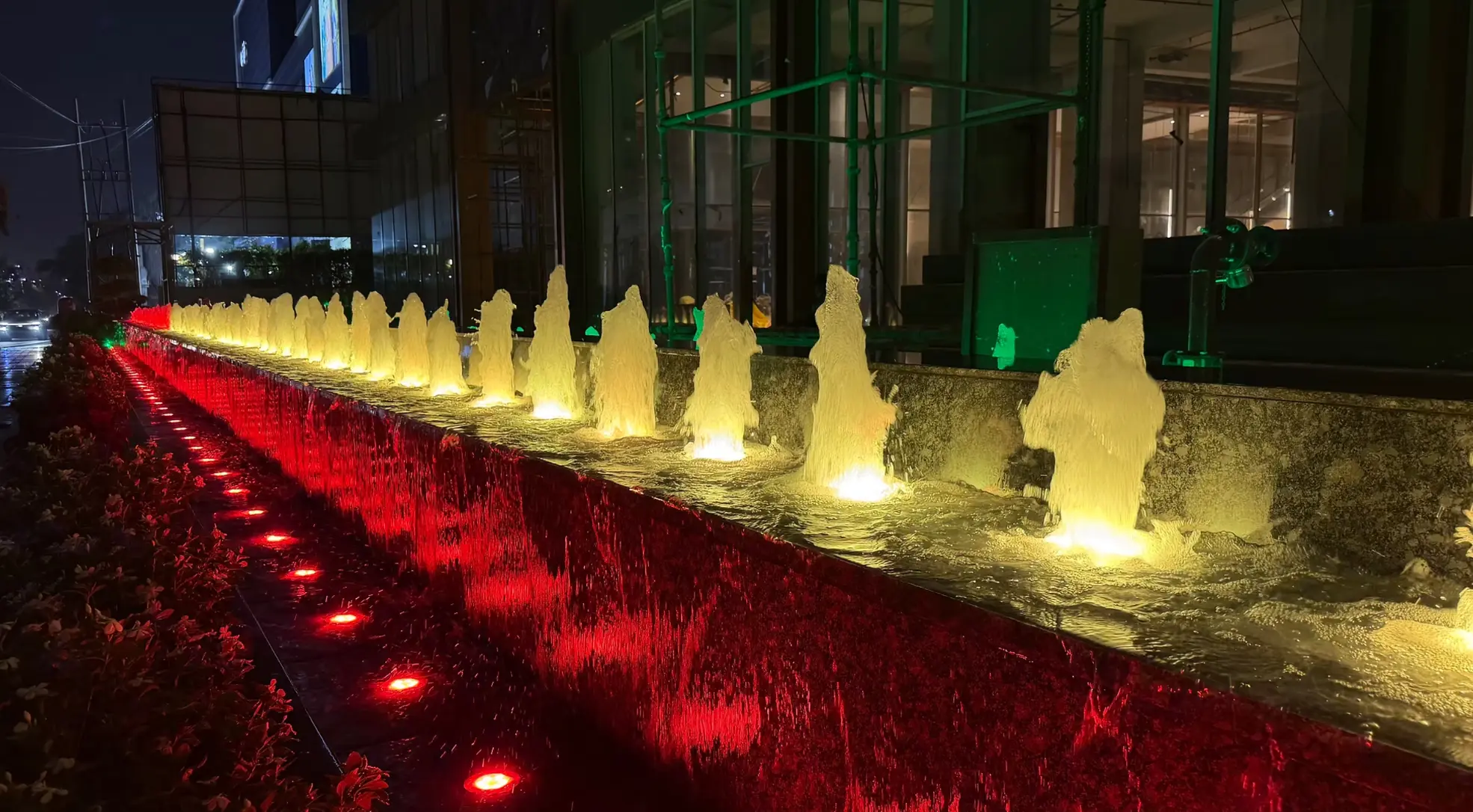
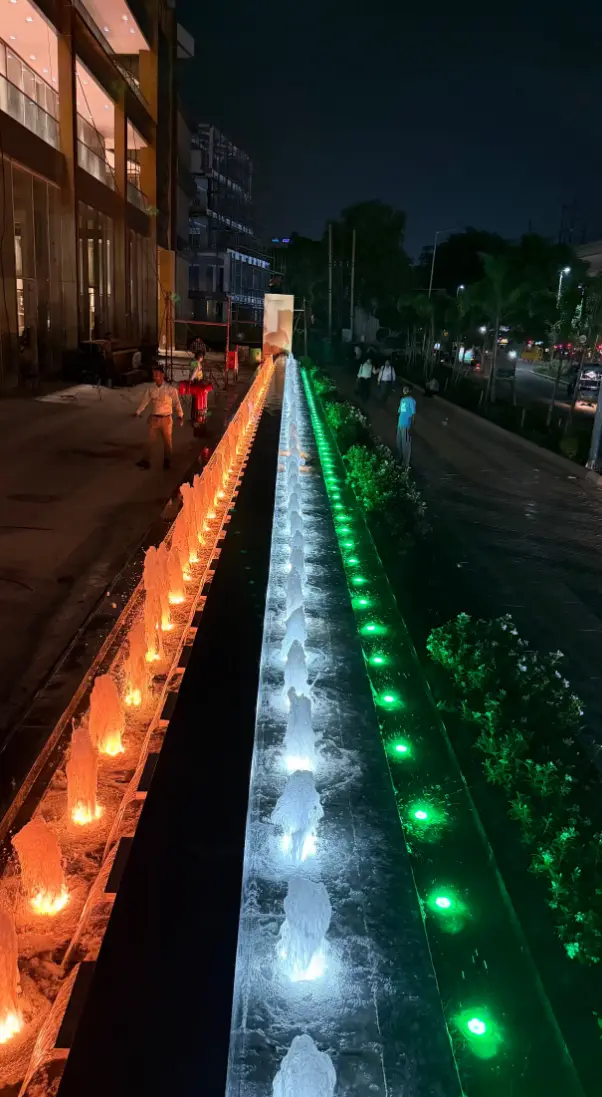
A fountain becomes more expressive when its lighting follows the movement of water. Gentle colour transitions create a calm architectural display, while precisely timed lighting sequences bring energy to a musical fountain show.
DMX control for fountain lights makes these effects possible by allowing a controller to adjust colours and brightness across individual lights or groups.
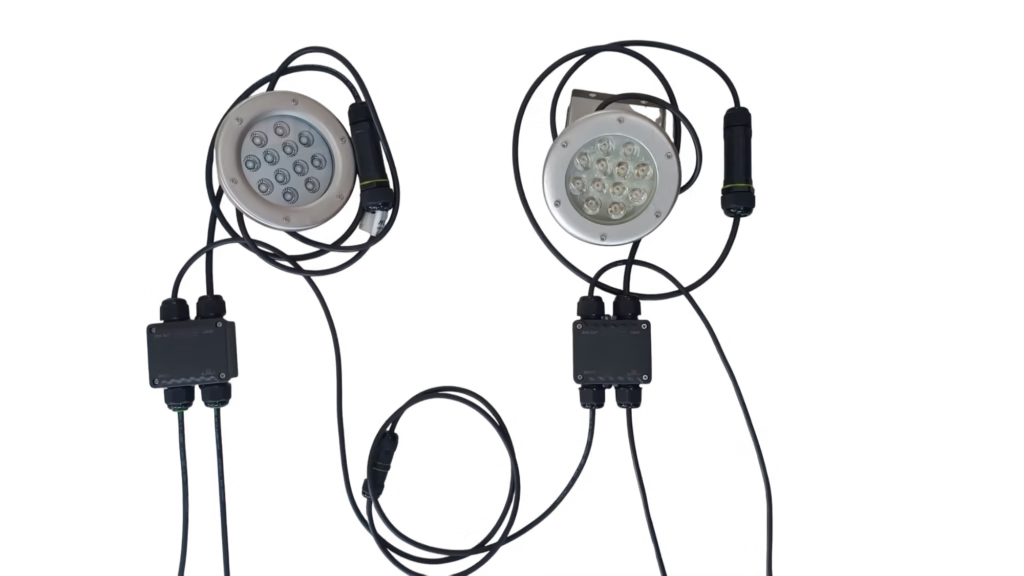
At Dhyani Technologies, we provide fountain lighting and automation solutions through our SyncD range. With a suitable underwater DMX decoder, compatible existing RGB and RGBW fountain lights can be integrated into a programmable lighting system—often without replacing the fixtures.
This guide explains how DMX fountain lighting works, which lights can be upgraded, and what to consider when planning a reliable installation.
DMX512 is a digital control protocol used to send lighting commands from a controller to compatible equipment.
In a fountain installation, a DMX controller sends values that determine the intensity of each colour channel. A decoder receives these commands and controls the connected light.
For a typical RGB fountain light, three channels control:
Red
Green
Blue
An RGBW light adds a fourth channel for White.
Adjusting these channels creates different colours and brightness levels. When changes are programmed over time, the fountain can display smooth fades, alternating colours, chasing effects and coordinated lighting sequences.
DMX carries control information. A separate, correctly rated power supply provides the electrical power needed by the lights.
Basic fountain lighting systems often run fixed colour-changing programs or operate all connected lights together. DMX adds more control over how the fountain looks and how its lighting responds during a show.
Independently addressed decoders allow different sections of a fountain to display different colours at the same time.
For example, a centre jet can glow white while an outer ring displays blue. A line of jets can create a colour chase, or separate fountain patterns can follow different lighting sequences.
DMX allows programmed brightness adjustments and colour transitions. This helps create both subtle architectural lighting and dramatic show effects.
Within a properly integrated fountain control system, lighting cues can be coordinated with water jets, pump speeds, solenoid valves and audio playback.
The decoder controls the lighting channels; the overall show controller and programming determine how those lights synchronize with other equipment.
A lighting upgrade does not always require replacing every underwater light. Where the existing fixtures have compatible electrical characteristics and remain in good condition, an external DMX decoder can provide a practical route to programmable control.
Many compatible low-voltage RGB and RGBW fountain lights can be converted to DMX control using an external DMX decoder - SyncD Underwater DMX512 Decoder.
Many compatible low-voltage RGB and RGBW fountain lights can be converted to DMX control using an external decoder.
Before selecting a decoder, check the following:
| Compatibility Check | What to Confirm |
|---|---|
| Operating voltage | The fixture voltage matches the decoder and power supply |
| Colour channels | Separate RGB or RGBW channels are available |
| Wiring arrangement | Common-wire polarity matches the decoder output configuration |
| Channel current | Each colour channel remains within the decoder rating |
| Internal electronics | The fixture’s built-in driver or controller is compatible with external control |
| Physical condition | Housing, cables, seals and connectors are suitable for continued use |
The SyncD decoder described here operates on 12–24 V DC. It must not be connected directly to a 110 V or 230 V AC fixture.
Lights with sealed automatic colour-changing electronics may require a different solution. Similarly, single-colour lights need an appropriate dimming arrangement and cannot gain RGB colour capability simply by adding a decoder.
At Dhyani Technologies, we assess fixture specifications and wiring before recommending a conversion.
The SyncD 3/4 Channel Underwater IP68 DMX512 Decoder connects compatible RGB or RGBW fountain lights to a DMX control system.
Its published specifications include:
| Specification | Details |
|---|---|
| Input voltage | 12–24 V DC |
| Control signal | DMX512 |
| Available versions | 3-channel RGB and 4-channel RGBW |
| 3-channel output rating | Up to 2 A per channel |
| 4-channel output rating | Up to 1.5 A per channel |
| Enclosure rating | IP68 |
| Standard cable length | 1 metre; customization available |
| Intended applications | Compatible fountain and underwater lighting installations |
Whether you are improving an existing architectural fountain or planning a musical water show, DMX control provides more freedom to shape colour, brightness and lighting sequences.
A typical system includes four main elements:
A matching DC power supply powers the decoder and connected fixture.
Larger installations may also need signal distribution equipment, multiple control branches and additional power circuits, depending on the fountain layout.
Start with the light’s rated voltage, total wattage, channel arrangement and wiring information. Inspect the cable, housing and seals as well.
Do not identify wire functions by colour alone. If documentation is unavailable, have a qualified technician verify compatibility before connection.
Choose a three-channel decoder for compatible RGB lights or a four-channel decoder for compatible RGBW lights.
For independent effects, each light or group needs independently controlled decoder outputs. Multiple fixtures connected to the same outputs will reproduce the same effect, and their combined load must remain within the permitted ratings.
Decoder selection must account for the current on each individual output.
Channel current = Channel power ÷ Operating voltage
For example, if one colour channel consumes 24 W at 24 V:
24 W ÷ 24 V = 1 A
That channel requires a decoder output capable of handling the load under the intended operating conditions.
Do not assume total fixture wattage is divided equally between colours unless the fixture specifications confirm this.
The power supply voltage must match the light. A 12–24 V decoder input range does not mean a 12 V light can be operated from a 24 V supply.
Power-supply selection should consider the maximum simultaneous load, manufacturer derating requirements and appropriate operating headroom.
Cable length also matters. Voltage drop can affect brightness and colour consistency, especially in low-voltage installations with long cable runs.
Each independently controlled decoder requires a starting address that matches the controller’s programming.
For a basic RGB configuration:
| Light | Starting Address | Channels Used |
|---|---|---|
| Light 1 | 1 | 1–3 |
| Light 2 | 4 | 4–6 |
| Light 3 | 7 | 7–9 |
| Light 4 | 10 | 10–12 |
For a basic RGBW configuration:
| Light | Starting Address | Channels Used |
|---|---|---|
| Light 1 | 1 | 1–4 |
| Light 2 | 5 | 5–8 |
| Light 3 | 9 | 9–12 |
| Light 4 | 13 | 13–16 |
These examples assume the decoder uses three or four consecutive colour channels. Always follow the actual channel map of the supplied device.
Installation should follow the approved wiring diagram and the electrical requirements for the site.
Verify power polarity, channel connections, DMX wiring and protective devices before energizing the system. Signal grounding, shielding and protective earthing should follow the equipment documentation and installation design.
Test each colour, dimming response, address and programmed effect before final commissioning. Follow the fixture manufacturer’s requirements for cooling during testing; some underwater lights must not operate dry.
Inspect every connector, seal and cable entry. An IP68 enclosure does not make an improperly assembled connection waterproof.
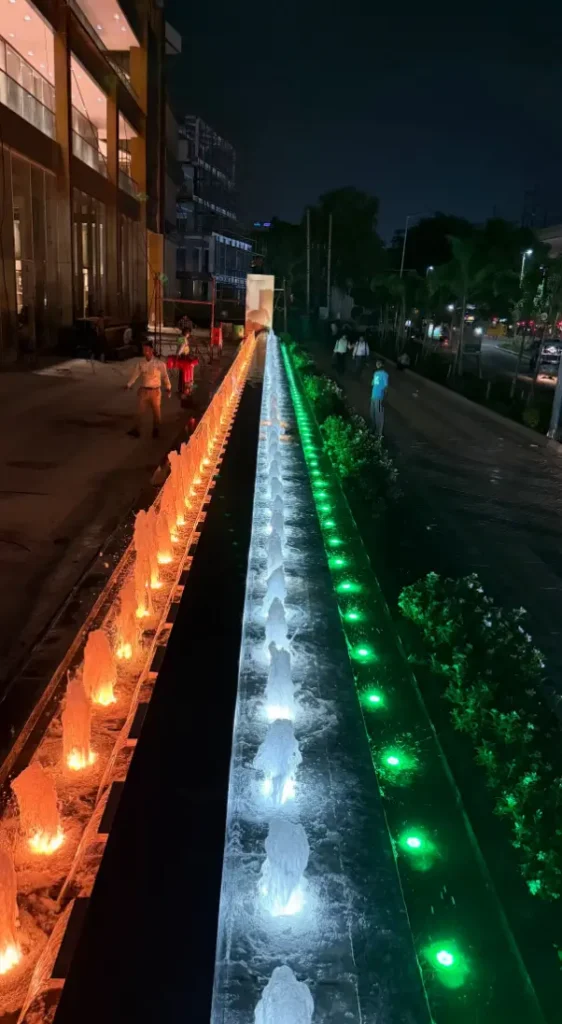
In a musical fountain, lighting should support the choreography.
A quiet section of music may use low-intensity blue or white light with gentle water movement. A faster section can introduce alternating colours, rapid chases and coordinated changes across fountain patterns.
Dhyani Technologies develops SyncD Pro, fountain show-control software with Art-Net and sACN integration. With suitable interfaces and connected control equipment, lighting can be coordinated with water effects and other show elements.
The result depends on the complete system: fixture placement, controller configuration, electrical design and choreography all contribute to the final display.
Explore SyncD Pro Fountain Show Software
A successful upgrade requires more than adding a decoder. Common problems include:
Checking these details during planning helps avoid rework during commissioning.
Yes, if the lights are electrically compatible and in suitable condition. Check voltage, channel wiring, polarity, current requirements and internal electronics before choosing a decoder.
An RGB decoder controls red, green and blue channels. An RGBW decoder adds a separate white channel for compatible RGBW lights.
Yes, when the wiring arrangement is compatible and the combined current stays within every applicable rating. Lights connected to the same outputs will operate together.
No. Music synchronization requires a suitable show controller or software, programmed cues and the necessary interfaces. The decoder follows the lighting commands it receives.
No. The power supply must match the light’s rated voltage, even when the decoder itself accepts a wider voltage range.
The installation must remain within the manufacturer’s specified submersion conditions. Connectors, seals and cable joints must also be suitable and correctly assembled.
Share the light quantity, voltage, wattage, RGB or RGBW configuration, wiring details, approximate cable distances and existing controller information. Photographs of the fixture label and connections can help with the initial assessment.
Whether you are improving an existing architectural fountain or planning a musical water show, DMX control provides more freedom to shape colour, brightness and lighting sequences.
At Dhyani Technologies, Vadodara, Gujarat, we help integrate compatible fountain lights with SyncD decoders and fountain automation systems.
Send us your fountain light specifications and layout to discuss compatibility and a suitable control solution.
Explore expert insights, practical guides, and the latest innovations in water show choreography, fountain design, and smart lighting technologies.
From musical fountain programming to advanced multimedia integration, our blog covers everything you need to create immersive and high-performance water shows in India and beyond.
We are recognised as noteworthy manufacturer and supplier of a broad assortment of Fountains such as Indoor Fountains, Outdoor Fountains and Digital Water Curtains.
Copyright © 2026 SyncD | Dhyani Technologies | All Rights Reserved.